
Curse of the Allflame - New Path of Exile 1 League
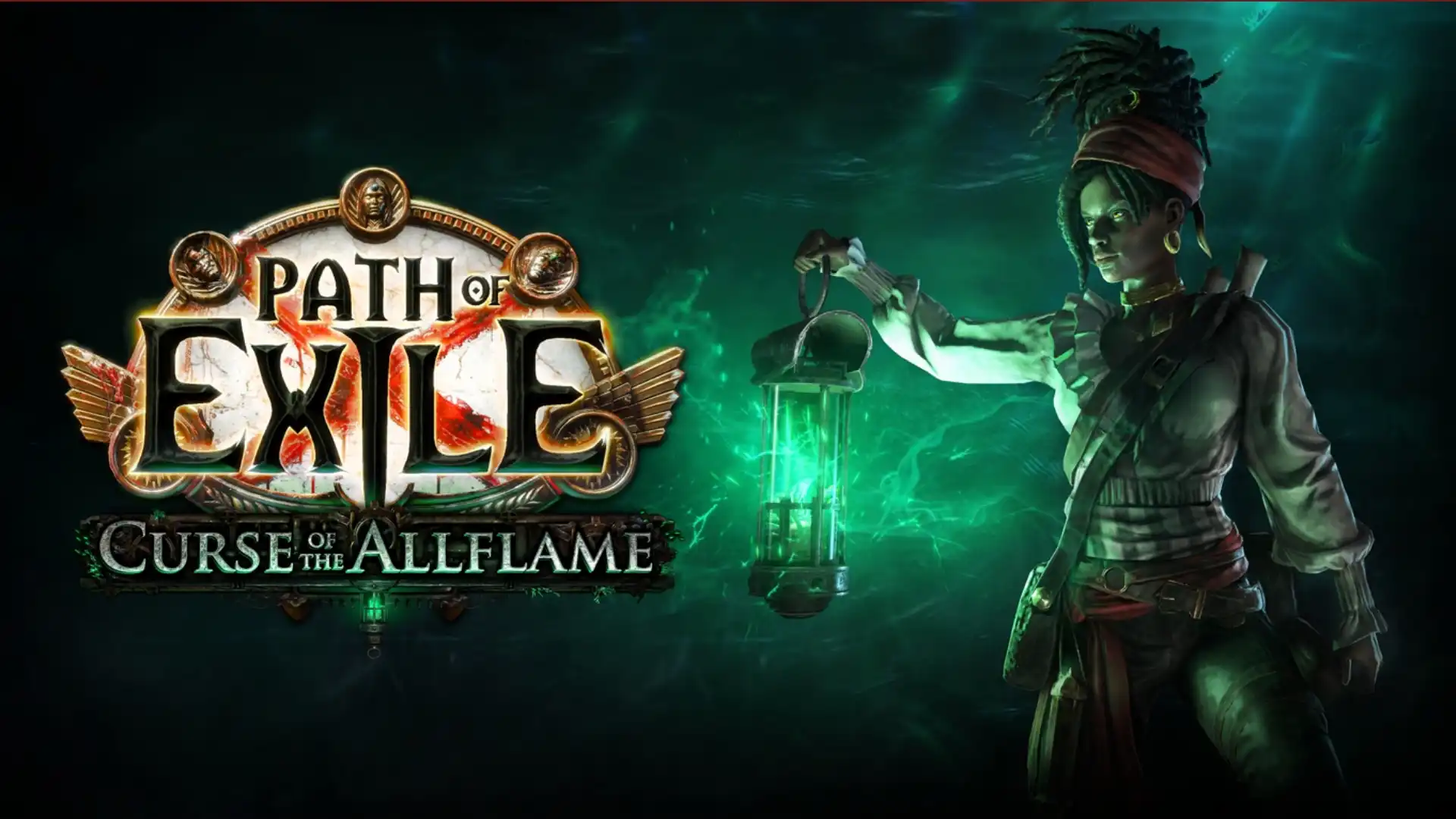
Path of Exile 1 is diving into deep water — literally. On July 16, 2026, Grinding Gear Games held their GGG Live reveal stream for patch 3.29, Curse of the Allflame, which launches as a full challenge league on July 24, 2026 at 1 PM PDT, replacing the outgoing Mirage league. The reveal broadcast peaked at over 201,000 concurrent viewers — one of the bigger numbers GGG has pulled for a reveal stream in recent memory — and for good reason. This isn't a small content patch sitting on top of the usual seasonal loop. GGG is reworking two of the game's oldest systems from the ground up, tearing out a socket-color system that's existed since the game's original release, running a full rebalance pass on spellcasters, and layering a brand-new underwater league mechanic on top of all of it.
If you've been away since Mirage, or even since 3.28 launched, there's a lot to catch up on. This covers everything currently known: the new league mechanic, the Abyss and Legion reworks, the socket overhaul, the spellcaster changes, the expected nerfs, the new Ascendancy, and a practical rundown of what to actually do with all of it before July 24.
The League Mechanic: Life as a Deep-Sea Salvager
Curse of the Allflame's core mechanic puts you to work for Valerie, a corsair captain, and her navigator Vesper, whose soul is bound to Valerie's ship — The Sovereign — by the eponymous cursed artifact, the Allflame. The framing gives Path of Exile its first genuine "boat expansion," and the mechanical loop is built around descending somewhere the game has never let you go before: the ocean floor.
The loop, broken down step by step:
- While running maps as normal, you'll come across Lost Charts, guarded by monsters. These are your entry ticket to the league content.
- Bring a completed chart aboard The Sovereign to travel to the location it points to on the sea floor.
- Once there, you descend in a diving contraption called the Bathysphere. The ocean floor isn't safe to simply walk around in — you place Allflame Lanterns as you go, which push back the water pressure and carve out breathable, fightable safe zones around them.
- Every chart carries its own modifiers, functioning similarly to how map mods currently work — expect affix-style difficulty and reward scaling per chart.
- Fully exploring a charted area reveals a Voyage Modifier, an additional twist layered onto the encounter once you've charted the whole zone rather than just rushing through it.
- Loot recovered from the depths includes Dead Man's Sulfur, the league's core crafting fuel, and Ducats, which function as the league's currency sink.
The crafting system tied to all this is called Allflame Crafting, done back at Vesper's forge aboard the ship. Rather than the traditional chaos-orb-style gamble where you strip a random modifier and get a random one back, Allflame Crafting lets you choose your desired modifier from a set of possibilities, at the cost of your accumulated Dead Man's Sulfur stockpile. This is GGG's latest swing at a long-standing community complaint: that endgame crafting has become both expensive and too randomized to plan around reliably. Directed crafting — picking the outcome instead of praying for it — has been one of the most consistently requested features over the last several leagues, and Allflame Crafting looks like GGG's most direct answer to that yet.
Worth noting: because this is the league mechanic, all of it (Charts, Voyages, Bathysphere descents, Allflame Crafting) is explicitly time-limited content tied to Curse of the Allflame specifically. Whether any part of it goes core once the league ends — the way some past league mechanics have — isn't confirmed yet.
Abyss Gets a PoE2-Style Rework
Abyss is one of the oldest league mechanics still active in the game, going all the way back to the Abyss league itself, and it's been due for a serious refresh for a long time. In 3.29, it's finally getting one — and the direction GGG has taken it brings Abyss much closer to how the mechanic already works in Path of Exile 2.
Here's what's changing:
- The old Abyss loop — chasing a meandering crack across the map, often having to backtrack when it curved away from you — is gone entirely.
- Abyssal pits are now open, spilling their energy out into the surrounding area rather than requiring you to trail a moving crack.
- Killing enemies that have been subjugated by the pit sends their souls down into it. This draws the attention of Abyssal Legion monsters tied to an entity called Kulemak, dwelling beneath.
- Kill enough subjugated enemies and the Abyssal Legion spills forth for a larger fight — effectively turning Abyss from a "follow the crack" mechanic into more of a "hold your ground and get swarmed" mechanic.
- Abyss is now the exclusive source of Abyssal Jewels and Stygian Vises, with the narrow exception that Abyssal Jewels can still rarely be found within Abyss biomes inside Delve.
- Abyssal Delirium Orbs have been removed from the game entirely — if you've been stockpiling these, that stockpile is now finite.
- A new endgame Pinnacle Boss has been added specifically to the reworked Abyss, dropping its own dedicated set of brand-new Unique items. GGG has deliberately left the access method for this fight undisclosed — expect the community to spend the opening days of the league figuring out exactly how to unlock it.
- Several Abyssal Jewel modifiers have been reworked as part of the transition — a number of "increased Damage with Hits and Ailments against Abyssal Monsters" style mods have either been removed or adjusted to make sense in the new, more open-ended version of the encounter.
Practically speaking, this is one of the two or three biggest structural changes in the entire patch. If Abyss was a mechanic you'd learned to mostly ignore because chasing the crack wasn't worth the time investment, that calculation is likely to change completely once the league launches.
Legion Reworked Around Unique Rewards
Legion gets a parallel overhaul in the same patch, with a stated design goal of giving it rewards that feel genuinely distinct from what Abyss and general map drops already provide — historically, Incubators and Timeless Jewels were about the only things that felt truly "Legion's own," and everything else overlapped with loot you'd get anywhere.
The confirmed changes:
- Breaking out key monsters, chests, and now the majority of regular monsters frozen in a Legion encounter is enough to start the fight — previously this was more restrictive and typically gated behind specific monster types.
- Legion monsters now drop fewer Splinters overall, but in larger stack sizes — a change clearly aimed at reducing inventory clutter and the kind of trade-price noise that comes from flooding the market with tiny, low-value stacks.
- Unrelenting Timeless Emblems have been removed outright, with many of the effects they used to provide folded directly into the regular Timeless Emblems instead. This simplifies the Emblem tier structure by cutting out a redundant layer.
- Legion Generals encountered in maps now have a chance to drop a brand-new currency item: Enshrouding Crystals. These can be used on Unique Armours specifically.
- Using an Enshrouding Crystal on a Unique Armour turns it Enshrouded, which makes it temporarily unequippable. To finish the process, you take the Enshrouded item to a new zone called the Domain of Timeless Conflict and fight through it — successfully clearing it transforms the item, presumably into an upgraded version, though exact outcomes weren't detailed in early reporting.
This gives Legion its own dedicated upgrade path for Unique Armour that doesn't exist anywhere else in the game, which is exactly the kind of "exclusive identity" GGG seems to have been going for with both this and the Abyss changes.
Socket Colors Are Basically Gone
This is arguably the single biggest quality-of-life change in the entire patch, and it undoes a system that has existed since Path of Exile's original 2013 release.
- All item sockets are now white by default. Any gem can go into any socket, as long as the item has enough total sockets and the correct number of links for whatever setup you're building. Socket color, as a gearing obstacle, is functionally gone.
- Socket colors haven't vanished completely, though — items can still roll Red, Green, or Blue sockets, each with a small independent chance per socket.
- If a gem's own color happens to match the socket it's placed into, you now get a small reward for it: +10% Quality on that gem.
- Chromatic Orbs have been repurposed to fit the new system. Using one on an item now guarantees at least one Red, Green, or Blue socket, replacing the old behavior of just rerolling all socket colors randomly.
- A number of color-dependent Unique items have been updated so their effects still make sense in a colorless world — they've been shifted to key off which gems are socketed rather than which color the sockets themselves are. The Triad Grip Unique gloves are a good example: they used to convert minion physical damage based on Red/Green/Blue/White socket colors, and now instead convert based on the color of the gem socketed in each slot. Divine Orbs can be used on existing copies of affected items to update them to the new wording.
For anyone who's ever burned a stack of chromatics trying to force a stubborn 4-off-color link on a 6-socket item, this is a huge accessibility win, plain and simple.
Spellcasters: The Rebalance Pass Players Have Been Asking For
GGG has a recent track record of running targeted balance passes on specific archetypes rather than blanket changes — wand attacks got attention in 3.27, Holy skills got theirs in 3.28. In 3.29, that spotlight lands on spellcasters, and specifically on self-cast builds.
What's confirmed so far:
- Spells are now being differentiated more meaningfully by damage type. Physical spells — Ethereal Knives and Bladefall are the two named examples — now come with a higher baseline critical strike chance than spells of other damage types.
- A number of "Adds Damage to Spells" modifiers found on gear have had their rolled values increased. One concrete example: a modifier that used to add up to 6 to 51 Lightning Damage to Spells now adds up to 8 to 66.
The broader stated goal is to make generic self-cast spellcasting genuinely competitive, rather than a build tax you pay for wanting to play a "normal" caster.
What's still unclear: whether Archmage Support itself is getting tuned down as part of this. The more likely scenario, based on how GGG has handled similar balance passes before, is some combination of generic buffs plus a modest Archmage adjustment — but the exact shape of that wasn't nailed down in early post-reveal coverage.
Minion Pact: The Gem Everyone Expects to Get Hit
If there's one single balance target the entire community has been circling since well before the reveal, it's Minion Pact Support, introduced back in patch 3.28.
- A basic level 20 Raise Spectre using a Dark Marionette has roughly 20,000 life on its own.
- Add a Minion Life Support gem and it climbs to roughly 36,000.
- That translates into approximately 1,000 flat physical damage added to whatever spell Minion Pact is supporting — before any passive tree, cluster jewel, or ascendancy scaling.
- For comparison, a normal level 20 Added Cold/Lightning Damage Support gem adds nowhere near that.
The resulting "Minion Pact Blade Vortex" build — particularly its safe Hierophant totem variant — became the single most popular skill setup in the first week of the Mirage league, roughly 13% usage. GGG banned it outright from the 3.28 Gauntlet event over the unhealthy meta it created.
If you were planning to league-start with Minion Pact Blade Vortex, have a backup build ready — this is about as close to a guaranteed nerf as pre-launch prediction gets.
Other Notable Nerfs and Shifts
- Screams of the Desiccated isn't expected to see a direct stat nerf — its main access point (via Mirage's league mechanic) is drying up alongside Mirage's exit, so expect its trade price to climb instead.
- Kinetic Fusillade, the dominant Mirage league-starter, is expected to see a moderate tuning-down.
- The Red Aquarian Ascendancy has been underwhelming since launch — buffs to its underused nodes are anticipated in 3.29.
New Content: Luminary Ascendancy and Mercenaries of Trarthus
Luminary is a brand-new third Ascendancy option for the Scion class. Once ascended, you can permanently recruit a Mercenary as a full combat ally — one whose equipment you can freely change and upgrade, opening up a whole new build axis.
The Mercenaries of Trarthus are returning and folding into core game content rather than remaining league-exclusive. A new endgame progression system called Atlas Anomalies has also been added. Talisman, an older mechanic, is also confirmed to be receiving a rework.
Release Timeline
- July 5, 2026 — Teaser trailer drops.
- July 16, 2026 — Full GGG Live reveal stream and official patch notes.
- July 20, 2026 — The Mirage league ends.
- July 24, 2026, 1 PM PDT — Curse of the Allflame officially launches.
Game Director Mark Roberts confirmed a 3.30 patch is already planned for later in 2026, timed around ExileCon 2026 (November 7–8, Auckland, New Zealand).
Practical Prep Checklist Before Launch
- Have a backup league starter ready if you were leaning on Minion Pact Blade Vortex.
- Don't stockpile chromatic-orb-dependent gearing plans — socket color is going away as a real obstacle.
- If Screams of the Desiccated is core to a build, budget for it to be expensive early on.
- Check whether Unique items you hold got their wording updated — some can be fixed with a Divine Orb rather than replaced.
- Watch the official patch notes thread directly before finalizing a starter build.
Once you're ready to gear up for launch day, check our PoE 1 currency catalog for league-start Chaos Orbs, Divine Orbs, and everything else you'll need.
Continue Reading: More PoE Guides